Decoding Progressive Jackpots: How They Stack Odds in Favor of Surprise Millionaire Makers
Iris Coleman · Apr 26, 2026

Decoding Progressive Jackpots: How They Stack Odds in Favor of Surprise Millionaire Makers
Progressive jackpots turn everyday slot spins into potential life-changers, pooling bets across machines or networks so prizes swell until someone hits the right combination; that's the core appeal, where small contributions from players everywhere build mountains of cash waiting for that one lucky trigger.
The Mechanics Behind the Growing Prizes
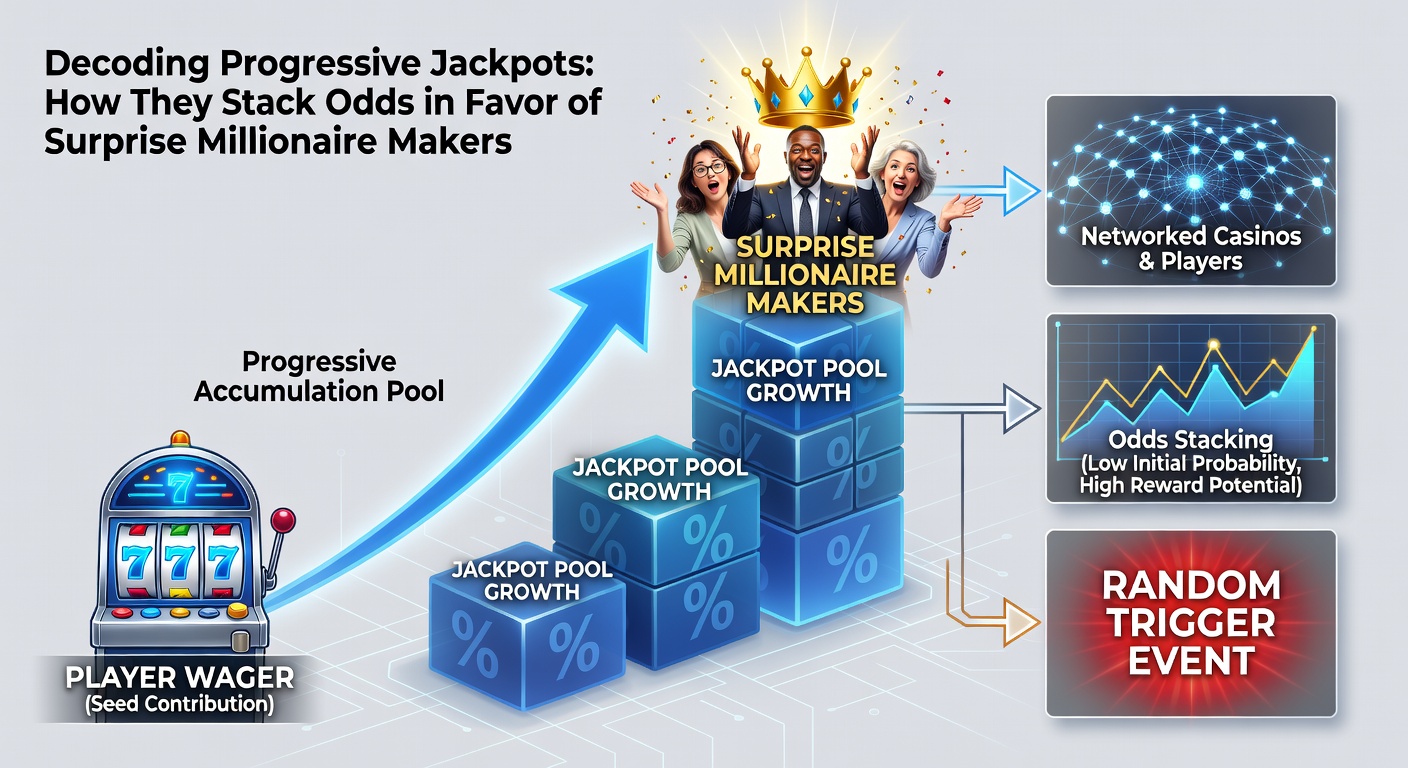
Operators link slots in progressives—standalone versions stay within one machine, while linked networks span casinos or even states—taking a slice from each wager, typically 1-10%, to feed the meter that climbs visibly on screens; this setup ensures jackpots reset to a base amount after wins, then start accumulating again, creating cycles that keep floors buzzing.
Wide-area progressives, like Nevada's Megabucks, connect hundreds of machines across multiple properties, channeling contributions into pots that routinely top $10 million; data from the Nevada Gaming Control Board shows these systems generated over $1.2 billion in payouts across the state in 2025 alone, with meters resetting dozens of times as players chase the elusive top tier.
But here's the thing: not all progressives behave the same; some feature multiple levels—mini, minor, major, grand—where lower tiers hit more often to sustain excitement, while the grand prize demands perfect alignments across paylines, often requiring max bets to qualify.
From Coin-Op Origins to Digital Networks
Slots evolved from mechanical reels in the early 1900s, but progressives emerged in the 1980s when IGT launched Megabucks in 1986, linking Nevada casinos for the first time; that debut produced a $1.7 million payout just months later, sparking a frenzy that spread globally, with European networks like Italy's Eurojackpot slots following suit by the 1990s.
Crunching the Odds: Long Shots That Pay Off Big
Experts calculate progressive odds using return-to-player (RTP) percentages, often dipping below 90% for top prizes due to the massive pools, yet overall game RTP hovers around 92-96% because frequent smaller wins balance the equation; for instance, Megabucks odds stand at 1 in 50 million per spin, a figure researchers at the University of Nevada Las Vegas's International Gaming Institute confirmed through simulations analyzing millions of cycles.
What's interesting is how contribution rates stack the deck subtly; a machine contributing 8% per $3 bet adds $0.24 to the pot each pull, so high-traffic floors accelerate growth—Las Vegas Strip casinos alone see billions wagered yearly, fueling jackpots that eclipse $30 million, as records from 2024 attest.
Players often overlook volatility here, where dry spells stretch months between hits, but data indicates jackpots average payouts every 3-6 months on major networks; that rhythm creates surprise winners, turning retirees or tourists into millionaires overnight.
Math That Favors the House, Yet Delivers Legends
House edges embed deeply—say 4-8% overall—but progressives amplify draw through visible escalation; studies from Australia's National Consumer Protection Framework reveal players allocate 20-30% more budget to progressives versus fixed-jackpot slots, chasing that "one more spin" allure even as probabilities remain steep.
Notable Wins That Shaped the Landscape
Take Cynthia Jay-Brennan, who in 2000 turned a $27 bet into $34.9 million on Megabucks at the Desert Inn, paralyzing her from the waist down in a prior accident yet claiming a payout that funded lifelong care; or Elmer Sherwin, hitting $4.6 million in 1989 at the Mirage, then repeating $21 million 14 years later at the Cannery—odds of 1 in 2.4 quadrillion, per casino logs.
Overseas, a Finnish player snagged €17.8 million on Mega Fortune in 2013, while in April 2026, a Canadian tourist at Niagara Fallsview Casino pocketed CAD 14.2 million from WowPot, as reported by Ontario's iGaming regulators, marking the network's biggest drop that quarter amid rising cross-border play.
These stories ripple; the American Gaming Association tracks how such hits boost venue traffic 15-20% for weeks, with social media amplifying the buzz—posts about wins garner millions of views, drawing fresh hopefuls.
And yet, for every headline-grabber, thousands grind smaller tiers; one study from Sweden's Spelinspektionen noted 85% of progressive payouts fall under $10,000, keeping games solvent while teasing the dream.
Current Trends in April 2026: Networks Expanding Online
Digital shifts dominate now, with online progressives like Divine Fortune or Divine Fortune Gold linking players across apps in regulated markets; New Jersey's Division of Gaming Enforcement reported $450 million in progressive-linked wagers for Q1 2026, up 18% year-over-year, as mobile access lets pots grow 24/7 without floor limits.
Operators innovate too—multi-game progressives tie video poker, blackjack side bets, even keno—while blockchain trials in Malta test transparent meters, verifiable via public ledgers; figures from the European Gaming and Betting Association show EU networks paid €2.1 billion last year, with April 2026 seeing a €28 million Hall of Gods drop in Sweden.
Regulators adapt swiftly; Pennsylvania's Gaming Control Board mandated clearer RTP disclosures in 2025, helping players gauge true shots, while Australian states cap contributions to curb problem play, balancing thrill with safeguards.
Myths Busted by the Numbers
People chase "due" jackpots after long droughts, but random number generators (RNGs) ensure each spin stands alone; testing by Canada's Alcohol and Gaming Commission of Ontario verifies fairness across 99.5% of audited progressives, debunking hot/cold machine lore.
That's where the rubber meets the road: progressives thrive on psychology, meters ticking upward like a countdown, yet math governs every outcome.
Regulations Keeping It Fair Across Borders
U.S. states like Nevada require minimum seeds—$10 million for Megabucks—to prevent endless chases, audited quarterly; Europe's Malta Gaming Authority enforces segregated funds for jackpots, ensuring payouts even if operators falter, a lesson from past collapses.
In Asia, Singapore's Gambling Regulatory Authority limits progressives to licensed resorts like Marina Bay Sands, channeling proceeds to community funds; data shows these controls stabilized growth, with jackpots averaging 25% higher yields post-implementation.
Observers note cross-jurisdictional networks demand harmonized standards—e.g., shared RNG certification—yet hurdles persist, as varying taxes (up to 50% in some spots) nibble winner nets.
Conclusion
Progressive jackpots decode into systems where tiny bets forge colossal prizes, stacking improbable odds into millionaire moments that define casino lore; from Megabucks origins to 2026's online surges, they pulse with potential, backed by rigorous math, oversight, and real-world payouts that keep the chase alive, even as houses hold steady edges.
Turns out, the surprise lies in persistence meeting pure chance—networks grow, winners emerge, and the cycle spins on, turning ordinary plays into extraordinary windfalls across global floors and screens alike.